Lake County covers more kinds of ground than its reputation suggests. Most people picture the lakefront and the mills and stop there, but the county runs from Hammond and Gary south through Merrillville and Crown Point, over the same Valparaiso Moraine that crosses Porter County, and down onto the Kankakee flats at Lowell and Schneider. That is about two hundred and twenty feet of rise and fall between the shoreline and the high ground in eastern Winfield Township, and the material underfoot changes at least three times on the way.
The water here does not behave the way a map suggests, and it is worth understanding before anyone quotes drainage on your property. Deep River and Turkey Creek run through Hobart and Merrillville, well inland from the lakefront, and they still drain to Lake Michigan. Deep River runs north; Turkey Creek runs east into it above Lake George. The west branch of the Little Calumet runs the opposite direction, west into Illinois and eventually to the Mississippi, and part of that river genuinely flows two ways depending on the stage of the water. The practical version is that this county does not drain one way. Water leaves it toward Lake Michigan, toward the Kankakee, toward the Iroquois and west through the Calumet system, and the drainage board runs two separate applications, one for the Kankakee River watershed and one for the Little Calumet. The first thing we settle is which one your site sits in. The Little Calumet drops somewhere between a foot and a foot and a half per mile and the Kankakee less than a foot per mile, which is why drainage in this county is patient, precise work rather than steep work.
Through the middle of the county, Crown Point, Merrillville, Schererville, St. John and Cedar Lake, the ground is heavy clay till. Ozaukee again, about forty-two thousand acres of it, the most common single soil in the county, with Pewamo sitting in the low spots. The old county soil survey's own language for working it is hard to improve on: highly plastic throughout, difficult to work, compact when wet. It holds water beautifully, which makes this the part of the county where a pond will seal without importing anything, and it fights you on nearly everything else. Shrink and swell on Pewamo is high enough that footings and flatwork have to account for it rather than hope.
North of the Little Calumet the ground stops being soil and starts being history. Large stretches of Gary, Hammond, East Chicago and Whiting sit on made land: slag, foundry sand, cinders, demolition debris and filled marsh. On the lakefront made land at Indiana Harbor, Gary Harbor and Burns Harbor it runs twenty to sixty feet and approaches eighty in places, and the water table across that ground is typically inside fifteen feet. Digging there is an environmental exercise before it is an excavation exercise. Hundreds of state institutional control records cover that ground, many restricting excavation or groundwater use outright, and spoil off a job like that is a waste classification question rather than a hauling line. We will be straight about it: that work belongs to crews who do it every day with an environmental consultant already engaged. If you call us about made ground in the industrial corridor, we would rather point you at the right people than learn on your property.
South of that line it is ordinary dirt work again, and the real constraint becomes paperwork. The county surveyor manages roughly six hundred miles of legal drain, with the statewide right of entry that runs seventy-five feet from the top of each bank of an open drain and seventy-five feet either side of the center line of a tile, narrowable by the board on newer and urban drains. The drainage board meets monthly with filings due two weeks ahead of it. The county also requires replacement storage at one and a half times whatever flood storage a project fills, and its ordinance sets no drainage area threshold on that at all, mapped stream or not. The square mile figure people quote is the state's threshold for a different permit, not the county's. Uncoated steel corrodes fast in nearly every soil in this county, so buried pipe and culvert specifications should not be copied off a central Indiana job. None of that is a reason to avoid the work. It is a reason to have it in the quote instead of finding it halfway through.
We did not choose this county off a map. The calls came out of the Calumet corridor and out of the farm townships in the south on their own, and the coverage followed them. There is no yard of ours in Crown Point and we will not pretend otherwise. What we run is one number that answers at any hour, a scope and a price written by us, and a vetted crew sent to the job under our name. Lowell, Schneider, and the West Creek and Cedar Creek townships are exactly the ground this company was built for, and exactly the ground a metro contractor will not drive out to for one pond.
One more thing about this county, and it is the part that moves a schedule more than the dirt does. The surveyor's office maintains six hundred miles of legal drain, and state law gives the county a right of entry within seventy-five feet, measured at right angles from the top of each bank of an open drain or from the center line of a tile. On drains established after 1984 and on urban drains that can drop to twenty-five feet from each bank or fifteen feet from a tile center line, and to seven feet each side of a tile inside a platted subdivision, so we look up the number for the actual drain rather than quote the ceiling. County stormwater standards hold most new development to two tenths of a cubic foot per second per acre across storms up to the hundred year, computed to each pre-developed outlet, with a site specific rate instead where there is depressional storage. Detention is sized for the hundred year storm. Where a pond is not fenced it wants a safety ledge six to ten feet wide, slopes of three to one or flatter below that ledge and six to one or flatter above it. And for a building beside the pond, the lowest adjacent grade sits two feet above the hundred year pond level or two feet above the emergency overflow weir, whichever is higher, with twenty-five feet between that hundred year elevation and any occupied building. The dams here are the region's problem rather than its scenery: seven of the ten on the national inventory carry a high hazard class, eight of the ten are rated in poor condition, and of the seven that report a completion year the middle one was finished in 1930, with the oldest dating to 1846.
Every service, county-wide
Common Lake County projects
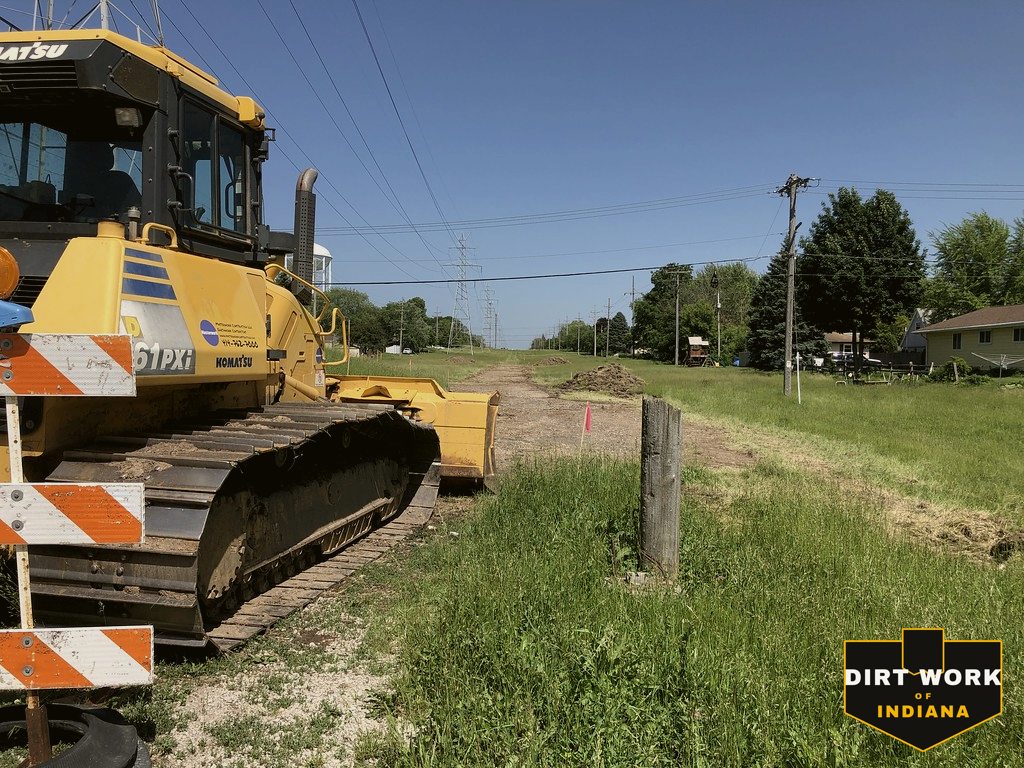
Drainage and regrades on heavy clay through Crown Point, Merrillville and Schererville, ponds on ground that will actually seal, farm lane and tile work in the West Creek and Cedar Creek townships, barn and structure demolition, building pads, and land clearing on the acreages around Lowell and Schneider.